

How to read a model kit box and instructions: Japanese and European markings
When you buy models from abroad, the box may arrive in Japanese, German or English. If you can't read it, the usual result is that something is missing: you assumed glue and paint were in the box and they weren't, or you assumed a new tool and got an old mould reissued. This article covers four things: what a box or product page shows, what you have to buy separately, the edition labels, and how to read the instruction sheet. It relies only on the manufacturers' own pages and instructions.
First, the scope. This article looks at Japanese and European makers' pages. Chinese makers' boxes were not read one by one, so they are not covered here. Box layouts differ from maker to maker, and every example below comes from one specific product page or instruction sheet. None of it can be taken as "all makers do this".
What the box and product page show
Airfix has a page on its website devoted to its own boxes. It lists eight elements: a history note, flying hours, a skill level (1 to 4), a paint chart, colour schemes, decals, the product number and the scale 1. Its paint chart gives suggestions in Humbrol paints 1.
Other makers have no such page, but their product pages show similar fields. The table below lists what could be read on a few specific pages:
| Product page | Fields you can read |
|---|---|
| Aoshima 1/24 RX-7 | スケール (scale), JANコード (JAN code), サイズ (size, overall length about 180 mm), デカール付属 (decals included) 2 |
| Hasegawa 1:24 AE86 | a 新金型 (new tool) label, 品番 (product number), コード (code), model length 176.5 mm, release date 3 |
| Kotobukiya PUNI☆MOFU | 製品サイズ (product size), パーツ数 (part count), 対象年齢 (target age) 15 and over, 品番, 初回発売月 (first release month), 発売月 (release month) 4 |
| Bandai ENTRY GRADE | 価格 (price), 発売日 (release date), 対象年齢 8 and over, 付属品 (accessories) 5 |
| Tamiya 37195 | Item No, Italeri number 1235, release date, overall length 311 mm, 使用する主なタミヤカラー (main Tamiya colours used) 6 |
| Revell product page | an icon bar with scale, age recommendation, part count and article number 7 |
Makers name these things differently, and not all of them list the same things. Age is one example: Bandai and Kotobukiya write 対象年齢, while Revell uses an icon bar. To compare sizes, fields like 全長 (overall length) or 完成時の全長 (length when finished) are more reliable than the scale alone. The scale pitfalls are covered in "Scale model scales".
Product numbers and barcodes
A product number is each maker's own code. Airfix product numbers start with A, and the first two digits stand for the series, so A04105 belongs to series 4 1. Revell's pages call it Art. Nr. 7, and Kotobukiya calls it 品番 4.
Japan's JAN code has 13 digits, is compatible with EAN, and starts with 49 or 45 8. The JAN code on the Aoshima page begins 4905083 2, and the コード on the Hasegawa page is 4967834211711 3. Both start with 49, which matches the description above. The official pages don't say where on the box the barcode is printed, so this article doesn't cover its position.
What to buy separately: glue, paint, tools
This is the point where beginners most often lose out. Makers word it differently on the box or product page:
| Maker | Original wording | Meaning |
|---|---|---|
| Aoshima | 「この商品はプラモデルキットです。組み立てには別途、模型用接着剤や工具等が必要です。」2 | Assembly needs model cement and tools bought separately |
| Kotobukiya | 「組み立てにはプラモデル用接着剤が必要となります。」4 | Assembly needs plastic model cement |
| Revell | 「Klebstoff und Farben (nicht enthalten) zur Fertigstellung gemäß Abbildung erforderlich」9 | To finish the model as pictured you need glue and paint, which are not in the box |
| Airfix | The Starter Set includes glue, paint and brushes. The Classic Kit is the kit alone, without glue, paint or brushes 1 | One brand, and what is included depends on the product type |
Two things to watch. First, not every product page carries this sentence. The Tamiya 37195 and Bandai ENTRY GRADE pages examined here have nothing like 接着剤別売 (adhesive sold separately) 65. Silence is not the same as "not needed", so judge for yourself whether the kit needs glue and paint. Second, check whether the kit is snap-fit or cement-type. Hasegawa's website sorts beginner kits into three steps: 「ステップ1:接着剤不要」 (Step 1: no adhesive needed), 「ステップ2:接着剤必要」 (Step 2: adhesive needed) and 「ステップ3:本格モデル」 (Step 3: full-scale model) 3. At Revell, Level 1 is a snap-fit kit that needs no glue, and Level 2 involves basic gluing 7.
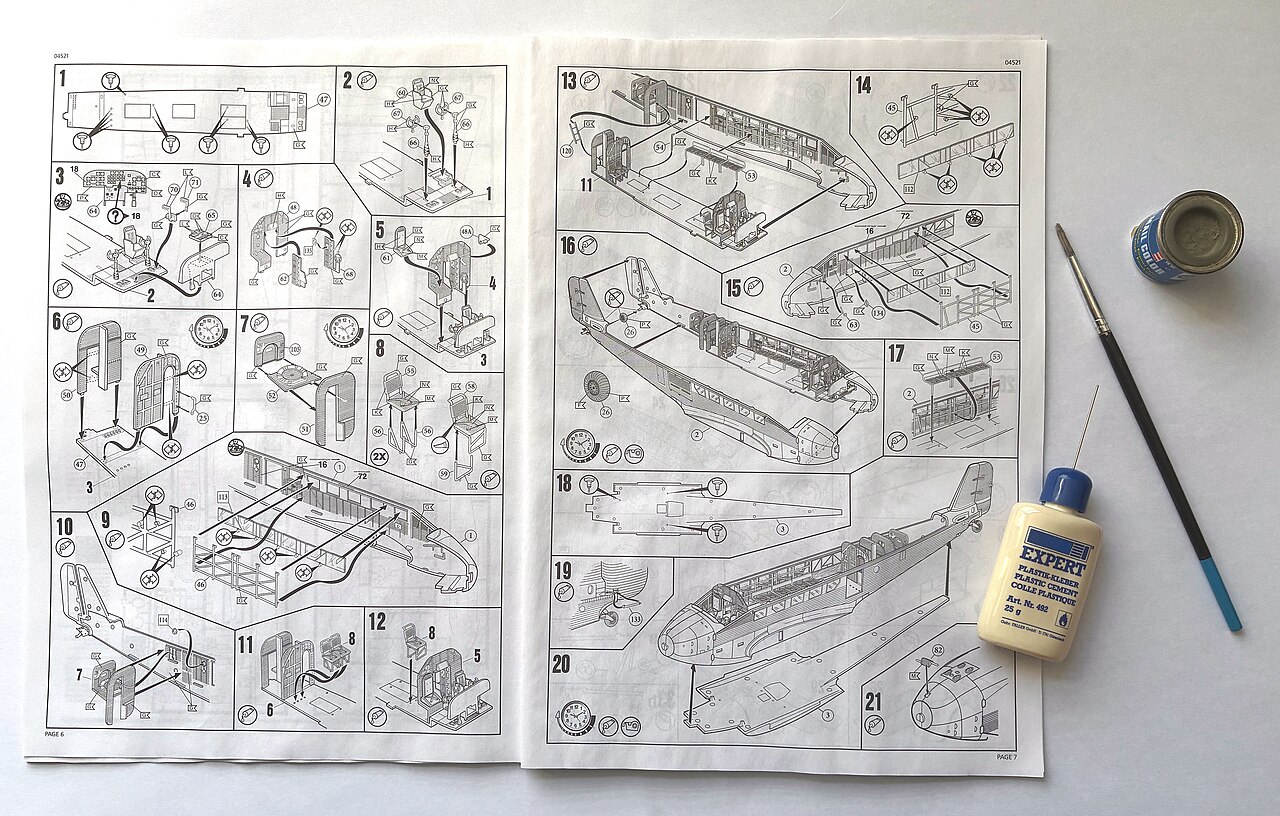
*Figure 1: An instruction booklet with separately bought plastic cement, paint and brushes (the booklet is Revell's Ju 52). Photo: Auge=mit, CC BY-SA 4.0, Wikimedia Commons.*
Edition labels: new tool, reissue, limited
Three terms are easy to mix up. One premise first: on makers' pages these are product labels, and no official page defines them across the board. Only the parts with an official basis are listed below.
- 新金型 (new tool): Hasegawa's product page tags the AE86 with 新金型, and the body text says 「完全新金型で再現」 (reproduced with an entirely new mould) 3.
- 再販 (reissue): on Hasegawa's monthly new-products page, each product is preceded by its scale and product type, reissues carry a separate 再販 tag, and the product number stays the same as before 10.
- 定番, 特別販売, 特別企画 and 限定: Tamiya has a page that defines them. 定番 is 「全国の模型店で販売されており、継続的に生産を行っている製品」 (products sold in model shops nationwide and in continuous production). 特別販売 means products that were out of production are made again specially, not on a continuing basis. 特別企画 means a product is made again after an interval following its first production run. 限定 means limited in quantity or period, and 「再生産は行われない」 (no reproduction takes place) 11. The classification is shown at the top of each product page, though some older products that are out of production have no label 11.
- 初回発売月 and 発売月: Kotobukiya's product page lists these two separately 4.
- Europe: the Revell Gloster Meteor page has "First Edition" in the product name, and says 「Limitiert auf nur 3000 Exemplare」 (limited to only 3,000 copies) and 「New Tool」 (a newly developed kit) 12. This is what one product's page says. No official explanation of what "Limited Edition" means at other makers was found here, so don't infer it from this one.
The upshot: the same word can mean different things at different makers, so go by how that maker writes it on its own pages.
How to read the instructions
Instruction layouts also vary by maker. Eduard's Spitfire Mk.Ia 1/72 instructions run to 20 pages, and their structure is a useful reference 13:
- The opening has notes in five languages (English, Czech, German, French, Japanese) 13.
- Then comes a row of symbols, such as OPTIONAL, BEND, SAND and REMOVE 13.
- Next are the parts diagrams arranged by sprue letter, with a separate mark for parts you won't use 13.
- A colour chart, matched to paint brand numbers. This one uses the H and C numbers of GSi Creos (GUNZE) 13.
- The step pages. Each step has part numbers, colour numbers beside the areas to paint, and boxes showing which colour schemes the step applies to 13.
- The colour scheme pages. Each scheme has a history note and multi-view drawings, and the numbers on the views are decal numbers 13.
- The last page marks the positions of the small decals 13.
A few points:
- A colour number is one paint maker's code and is not universal. Eduard's colour chart uses Gunze numbers 13, Airfix recommends Humbrol 1, Tamiya's product page lists 「使用する主なタミヤカラー」 (main Tamiya colours used) 6, and the Italeri page gives US Federal Standard F.S. numbers besides its own paint numbers 14. If you use another maker's paint, you have to find the matching colours yourself.
- The colours on the box may differ from the instructions. Revell says in its FAQ that the colours on the packaging are the base paint scheme, and that detailed colour advice is in the instructions 7.
- The instructions may have an updated version. Eduard's instructions tell you to check the website for the latest version 13.
- Multilingual instructions: the Revell Gloster Meteor page says delivery includes 「Bebilderte, mehrsprachige Bauanleitung」, an illustrated multilingual instruction booklet 12. Eduard's notes are also given in five languages side by side 13.
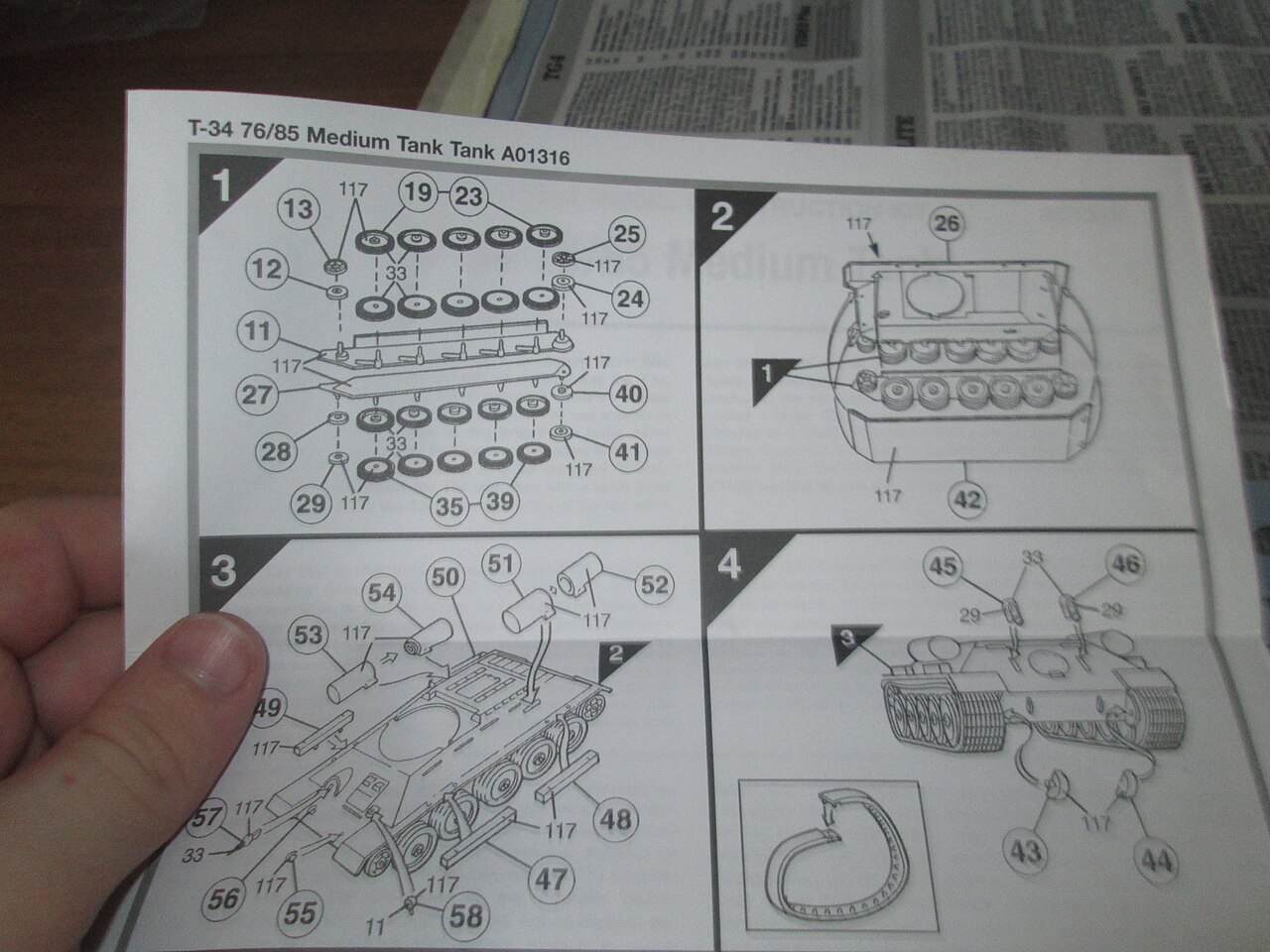
*Figure 2: A page of Airfix T-34 instructions. The circled numbers and small boxes in the step drawings refer to parts and colour schemes. Photo: TheRustler45, CC BY-SA 4.0, Wikimedia Commons.*
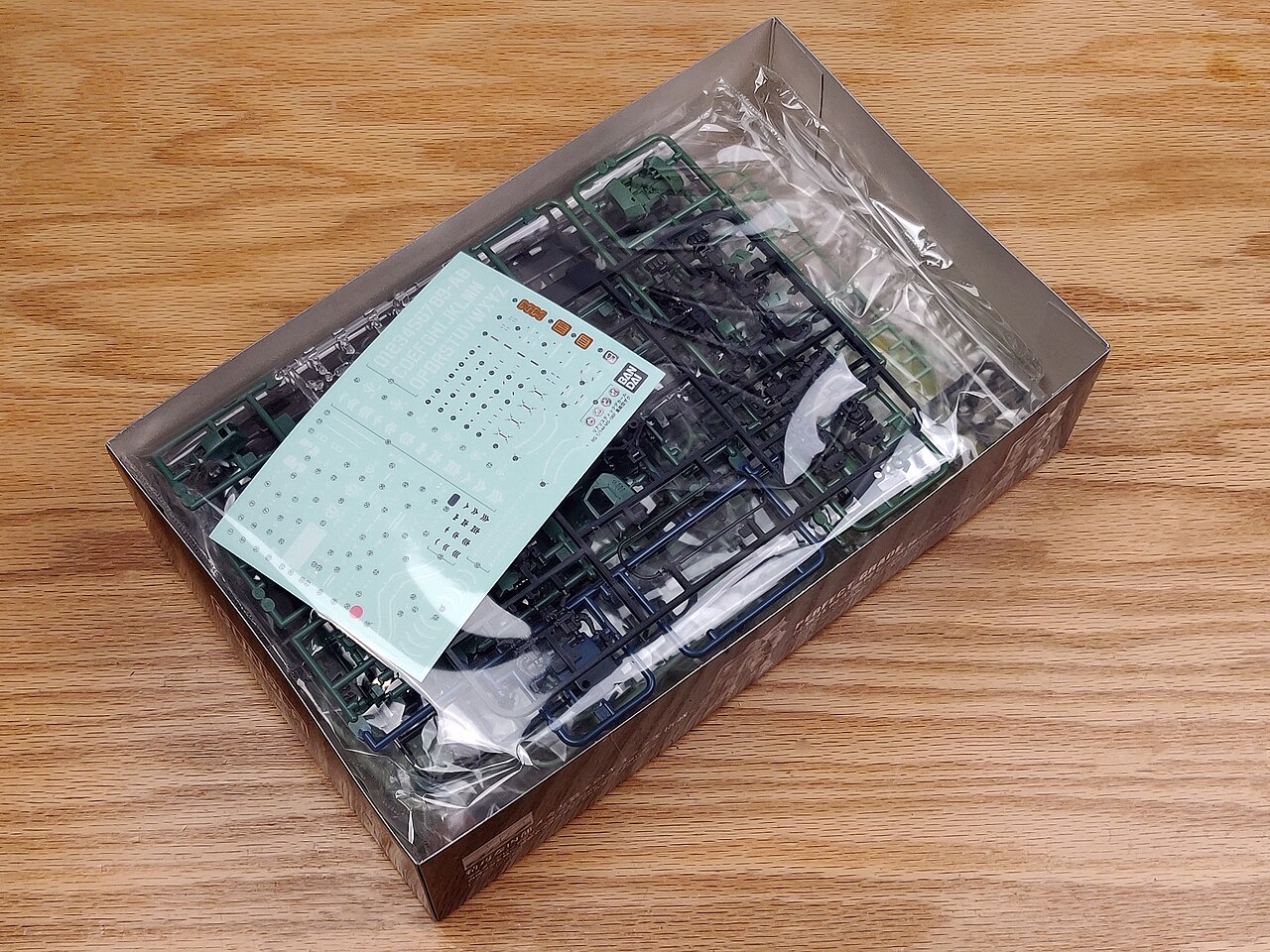
*Figure 3: An open box, with the sprues bagged separately and the decal sheet set aside (a Bandai kit). Photo: Gravis, CC BY-SA 4.0, Wikimedia Commons.*
Skill levels
Airfix rates difficulty from 1 to 4 on the box. Its website says that the higher the level, the more parts there usually are and the harder the build 1. Revell has a Level system too: Level 1 is a snap-fit kit that needs no glue, and Level 2 needs basic gluing 7. Each maker's levels follow its own standard and are not interchangeable. For more detail, see "Plastic model kits for beginners".
Common pitfalls
- Treating the scale as the size. Aoshima's 1/24 RX-7 is about 180 mm finished 2, while Tamiya's 1/72 EF-111A is 311 mm 6. A smaller scale can still be a very large model, so look at the 全長 (overall length) field.
- Ordering without checking for 別売 (sold separately). Even within Airfix, the Starter Set includes glue and paint and the Classic Kit does not 1.
- Taking the picture on the box for the finished model. The Aoshima page says 「画像はイメージです」 (the image is for illustration) 2, and Kotobukiya says the picture shows a prototype that was also painted for photography 4.
- Taking the colours on the box as the colours the instructions recommend. Revell states that the two differ 7.
- Taking a reissue for a new tool. Hasegawa's new-products page marks 再販 separately and keeps the old product number 10, so check for that label before buying.
- Applying one maker's labels to another. Limited, reissue and new tool are written differently on each maker's pages; see "Edition labels" above.
Related terms
Sources
The numbers match the [n] in the text. All accessed on 2026-10-13.
- Airfix: What's on the box
- Aoshima (アオシマ): 1/24 Suzumiya Haruhi no Yuutsu FD3S RX-7 '02 product page
- Hasegawa (ハセガワ): 1:24 Toyota Sprinter Trueno AE86 GT APEX early type (HC71)
- Kotobukiya (壽屋): PUNI☆MOFU Racing Run with Honda Z50J Gorilla product page
- Bandai Hobby Site (バンダイ ホビーサイト): ENTRY GRADE 1/144 RX-78-2
- Tamiya (タミヤ): Italeri 1/72 EF-111A Raven (37195)
- Revell: Starter Kit R.M.S. Titanic (includes FAQ)
- Wikipedia: International Article Number (section on Japanese Article Number)
- Revell: Level-System (in German)
- Hasegawa (ハセガワ): October 2026 new products
- Tamiya (タミヤ): What are special-sale, special-planned and limited products? (特別販売製品、特別企画製品、限定製品とは?)
- Revell: Gloster Meteor F.8/FR.9 First Edition (in German)
- Eduard: Spitfire Mk.Ia 1/72 ProfiPACK instructions (70202)
- Italeri: Macchi MC.202 Folgore (3172)
Updated 2026-10-13