

Model Trains
Model Trains: a beginner's guide
This is the beginner's guide to model trains. Each topic has one or two articles behind it — read this page for the overview, or jump into an article to go deeper on one question.
Where to start
Settle on a scale and how much space you have before anything else — that's the step beginners skip most often, and the one that's most expensive to undo.
How to use this guide
The learning path below is in order; later articles assume you've read the earlier ones. You can also skip around — every article links back to related terms, plus the previous and next article.
Scales at a glance
The same coach shrunk to each of the common scales and measured against one ruler.
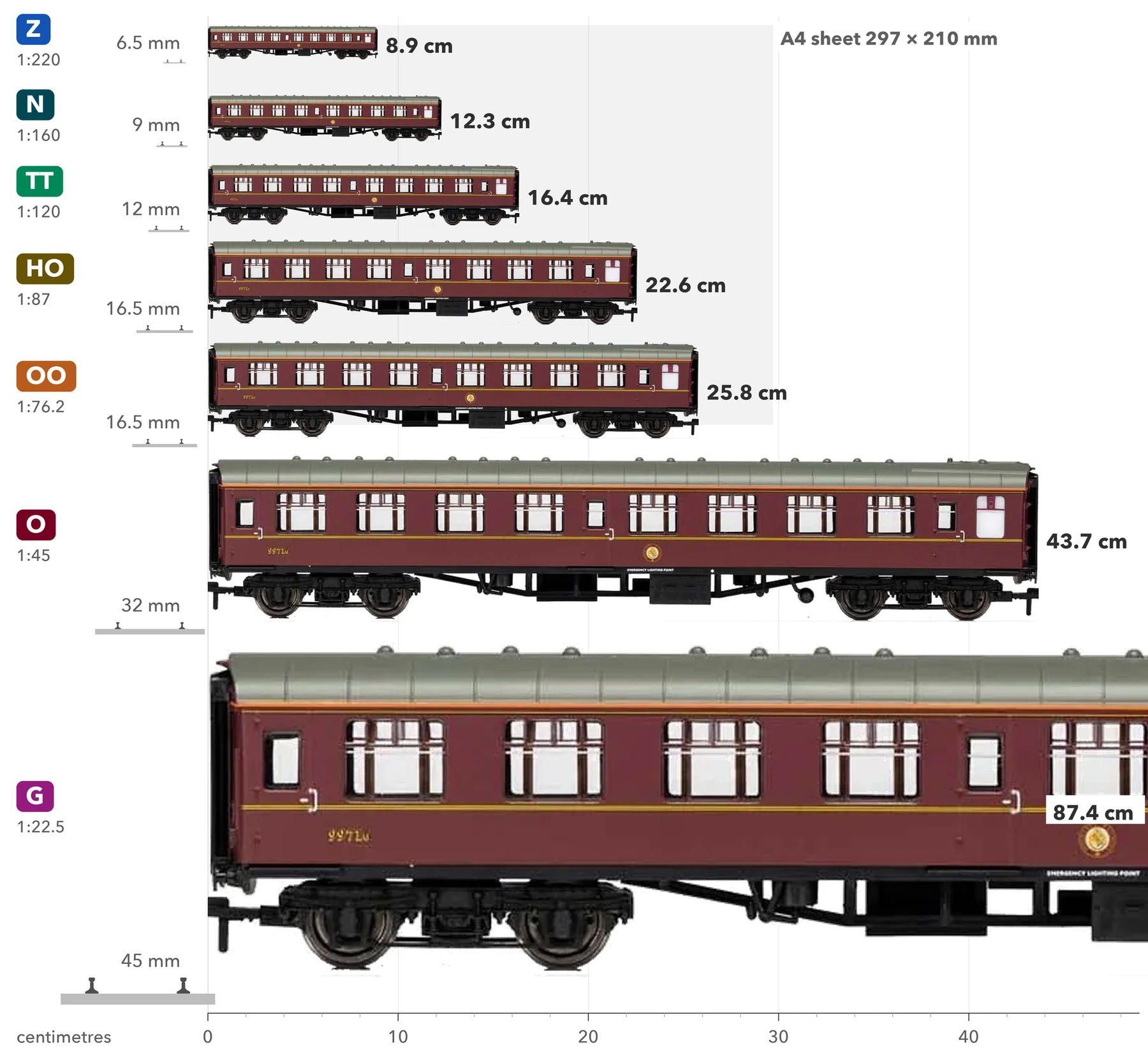
Narrow gauge at the same 1:87: H0m runs on 12 mm, H0e on 9 mm. Same gauge does not mean same scale. British OO is 1:76.2 and Japanese 16-ban is 1:80, and both run on 16.5 mm track.
Learning path
Reading in order is the least work. The articles still in progress will follow.
Published
Scales and gauges: choosing between Z, N, TT, HO, O and G
Published
AC or DC, analog or DCC: choosing how your model trains are powered
In progress
The main brands: what each is good at, and what it costs
In progress
Getting started with model trains
Know what you want?
Once the scale is settled, post what you're after on hobbeex and we'll find it, price it and bid for it on the Japanese and German second-hand markets.