

AC or DC, analog or DCC: choosing how your model trains are powered
Before buying HO model trains, there are two electrical questions to settle. Do you go with Märklin's three-rail AC or the two-rail DC used by most other brands? And do you use traditional analog control, or digital control with a decoder in every locomotive? This article explains what each choice means, whether the two kinds of trains and track can be mixed, how a beginner should choose, and how to tell AC and DC versions apart on second-hand sites.
Two camps: Märklin three-rail AC vs two-rail DC
In HO today, two power systems compete 2.
The first is two-rail DC (German: Zweileiter-Gleichstrom, often shortened to 2L or DC). The two rails are insulated from each other and connected to the two poles of the power supply 2. The wheels also have to be insulated, so that the left and right rails are not short-circuited. Trix and Fleischmann work this way 910, and Roco's standard versions are two-rail DC as well 11.
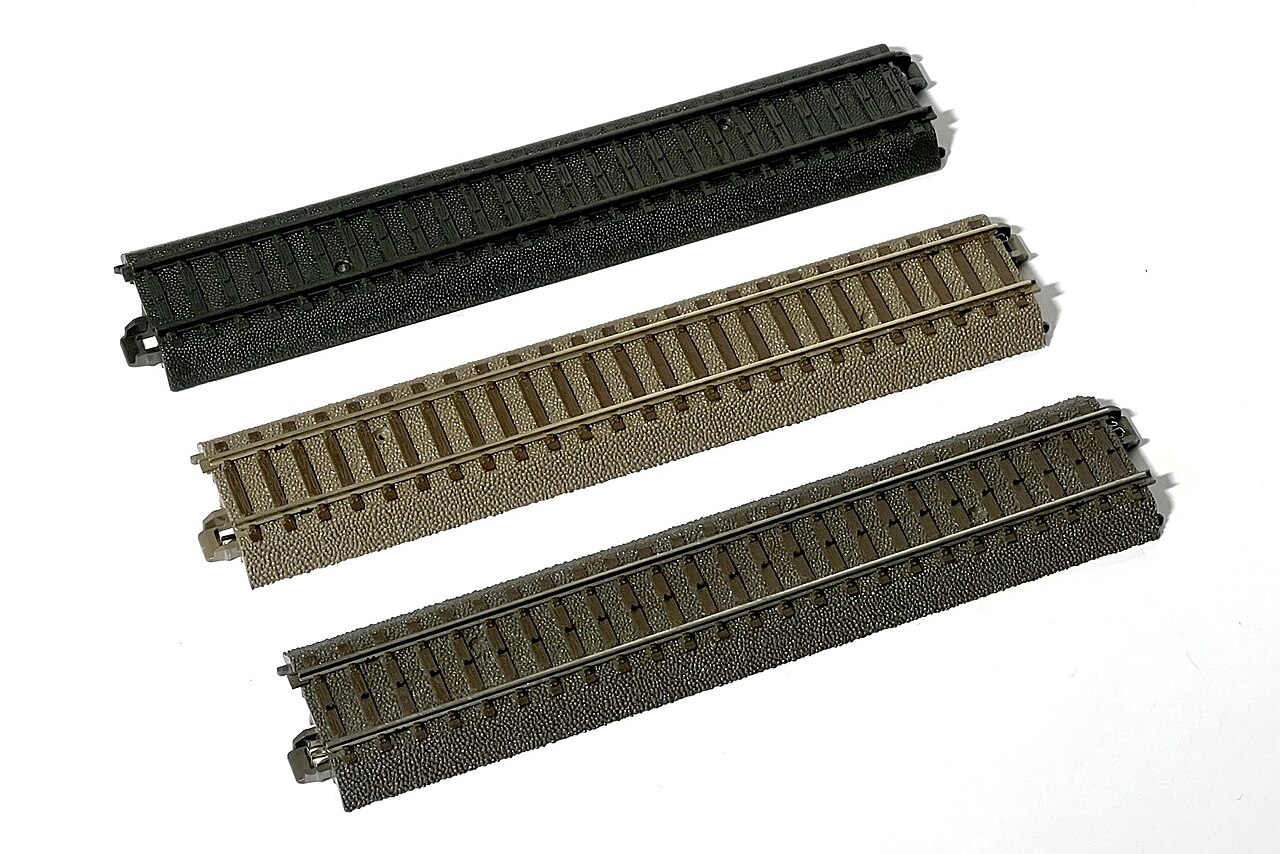
The second is three-rail AC (in German usually Mittelleiter, "centre conductor"; shortened to 3L or AC), which is mainly associated with Märklin 2. The two running rails are connected together as one pole, and the other pole runs down the middle of the track. Since the mid-1950s, Märklin has replaced the visible third rail with a comb-shaped conductor hidden under the sleepers, so only a row of small studs shows 12. These studs are the centre contacts (German: Punktkontakte). Under the locomotive is a long pickup shoe, the slider (German: Schleifer), which rubs along the studs to collect power 12.

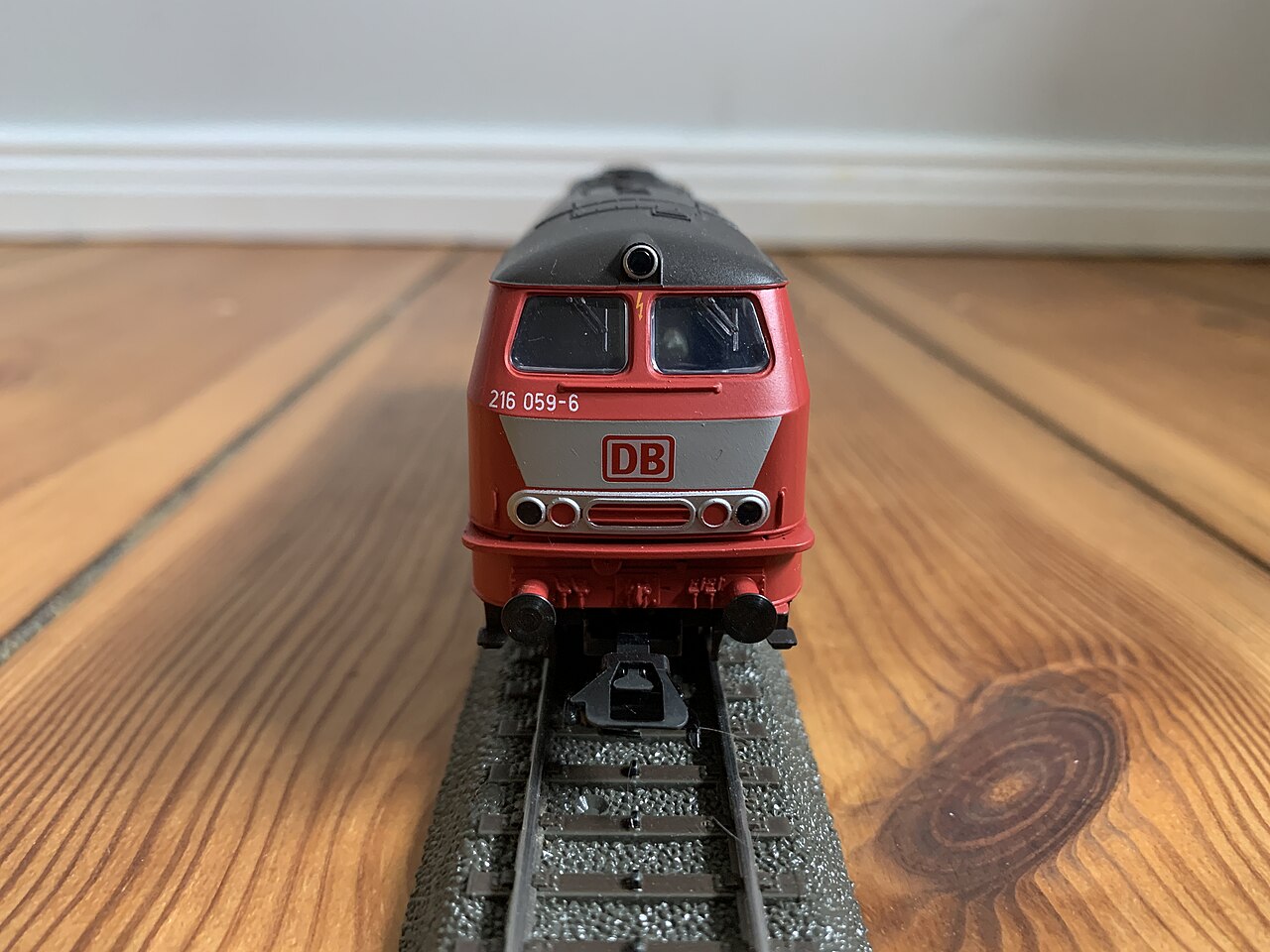
How the two systems differ:
| Two-rail DC | Märklin three-rail AC | |
|---|---|---|
| Look | Only two rails, closer to the real thing 2 | A row of studs down the middle, visible up close 12 |
| Reversing loops and wyes | Need special wiring, or they short-circuit 2 | No special wiring; any track shape works 12 |
| Wheels | Must be insulated | Not insulated 1 |
| Typical brands | Roco, Trix, Fleischmann (whose HO range is now sold as Roco) 91011 | Märklin 12 |
A reversing loop (German: Kehrschleife) is a loop that lets a train turn around. On two-rail track, after going round the loop the left and right rails have swapped polarity, so joining the loop back up causes a short circuit. That is why it needs a dedicated switching circuit 2.
Can the two kinds of trains and track be mixed?
| Situation | Result |
|---|---|
| Märklin AC locomotive or car on two-rail DC track | It short-circuits. Märklin wheels are not insulated, so a single wheelset connects the left and right rails 1 |
| Two-rail DC car (without lighting) on Märklin track | Mostly works 2; lighting needs modifying, and at older turnout frogs it may derail because of different wheel spacing 2 |
| Two-rail DC locomotive on Märklin track | It won't run. It has no slider, and Märklin's two running rails are the same pole, so there is no voltage between the wheels 2 (the editor's reasoning from how the system works) |
Can you convert them? Turning a DC model into an AC one means fitting a centre slider, and whether that is possible depends on how the model is built 2; Roco sells AC sliders as a separate part 12. Turning an AC model into a DC one means fitting insulated wheelsets, which is much harder for a locomotive 2. Beginners are better off not trying either.
Analog control and digital control
Analog control: changing the voltage
Analog is the traditional way: the controller changes the voltage on the track, and the higher the voltage, the faster the train goes 3.
- Two-rail DC: swap the polarity of the supply and the train runs backwards 3.
- Märklin AC: a brief high-voltage pulse triggers a reversing switch inside the locomotive 3.
The main limit of analog control is that every train on the same section of track gets the same voltage. To run several trains independently you have to split the layout into many sections and switch power to each one on and off 3.
Digital control: every locomotive has its own address
Digital control keeps the track powered all the time and encodes commands into the electrical signal. Each locomotive carries a decoder with its own address and only acts on commands sent to that address 4. That means you can control any number of trains separately on the same track 34, and switch lights and other functions individually 8.
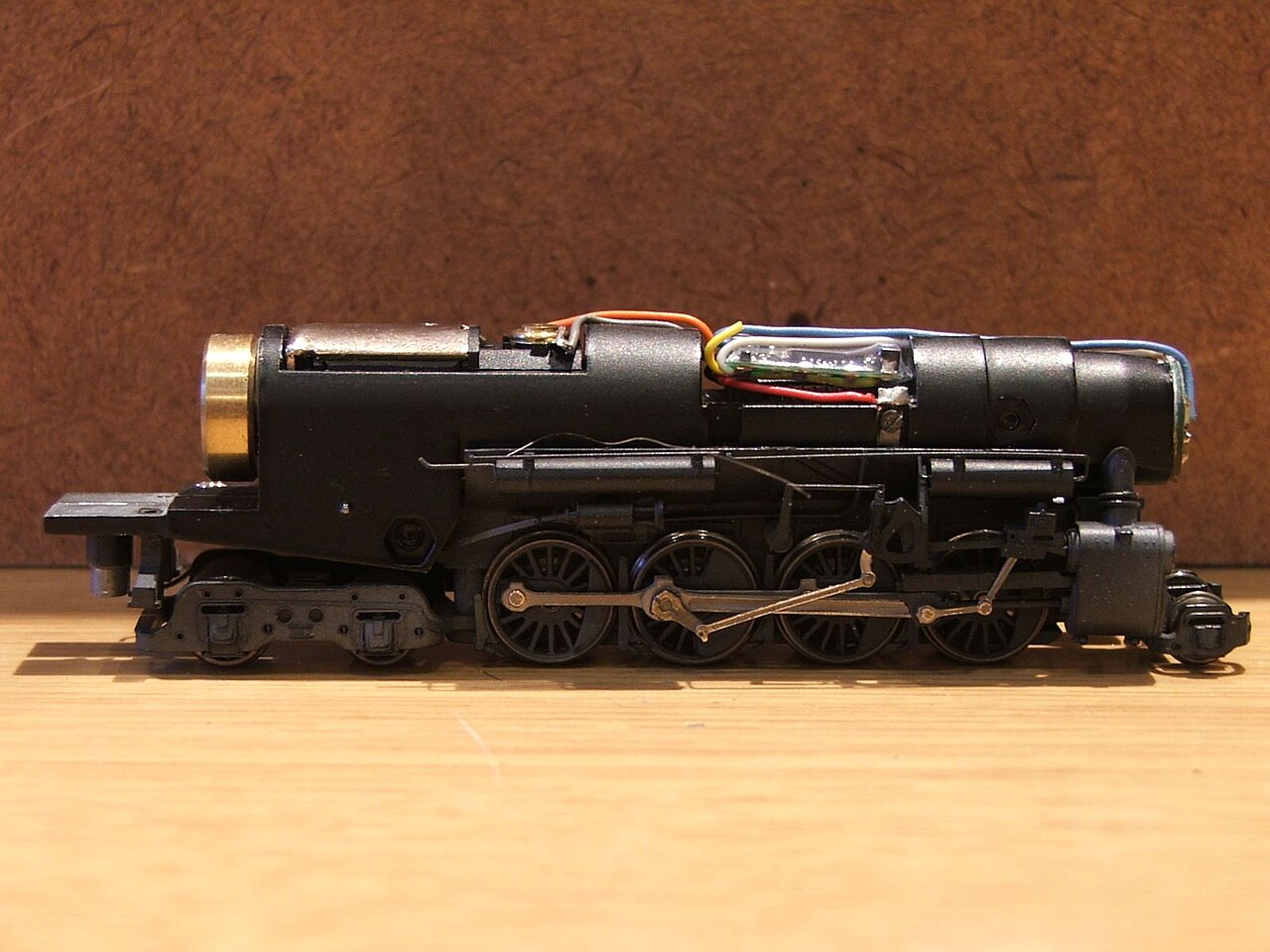
There are three main digital protocols 3:
| Protocol | Who uses it | Notes |
|---|---|---|
| DCC (Digital Command Control) | Standardised by the US NMRA; used by most two-rail DC brands | Lenz developed an early system, and the NMRA built its protocol on it; the first commercial systems were shown at the 1993 NMRA convention 4. The standards are numbered S-9 45. Products from different makers that meet the standard work together, and the NMRA issues an ID number to makers whose products pass 5 |
| Märklin Motorola (MM) | The first protocol of Märklin's AC digital system | Based on Motorola chips, introduced in the mid-1980s 16 |
| mfx | Märklin's newer protocol, since 2004 36 | A locomotive registers itself when placed on the track, reporting its name and functions, so you don't have to set an address by hand 678 |
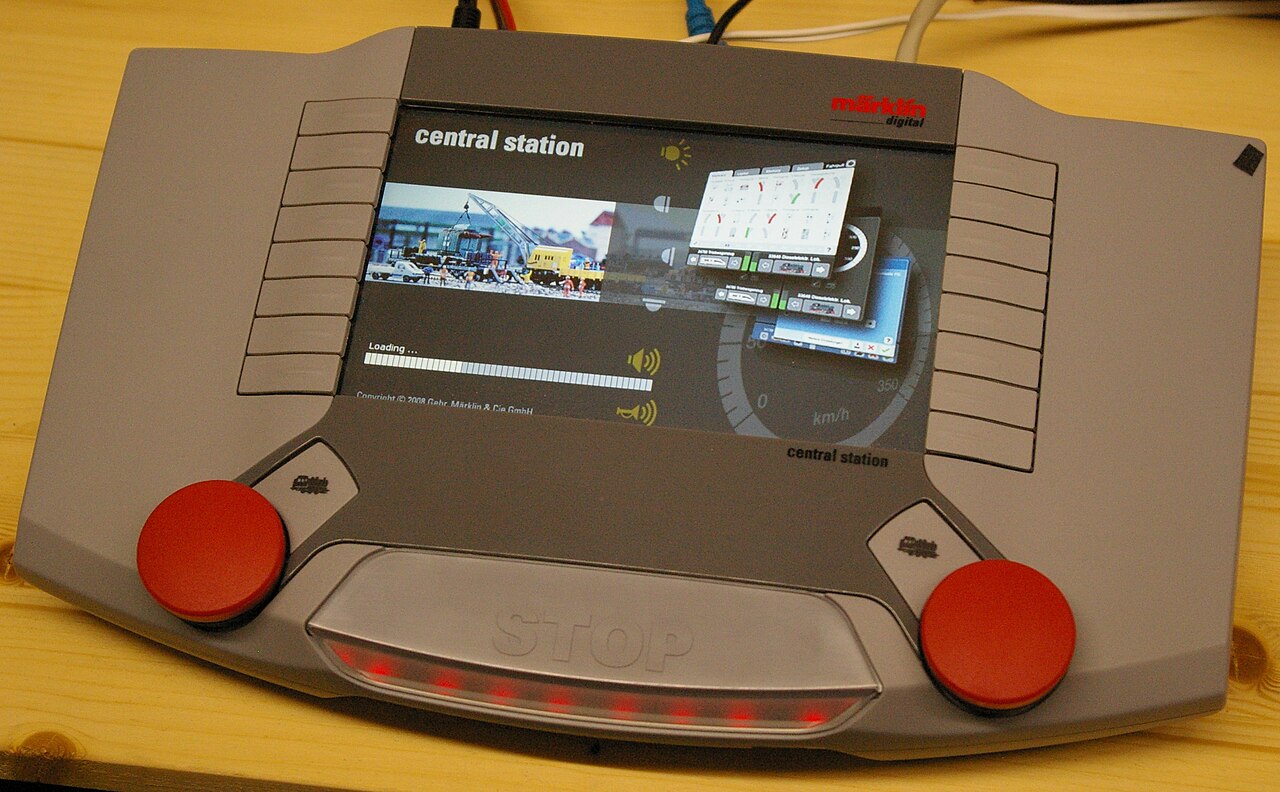
Märklin's Central Station controller supports Motorola, mfx, mfx+ and DCC 7.
When do you need digital?
The editor's suggestions:
- If you only want to watch one train go round, analog is enough. It is cheaper and simpler.
- If you want to run two or more trains at once, or control sound and lights one by one, go digital. That is what digital control was designed for 34.
- If you buy a new Märklin starter set, the choice is already made: current sets are digital, with an mfx decoder in the locomotive and a Mobile Station controller 8.
Going digital does not remove the difference between AC and DC. A digital protocol only changes how commands are sent; whether the wheels are insulated, whether there is a slider, and whether the track is two-rail or three-rail all stay the same (the editor's summary based on the points above). A two-rail DC locomotive with a DCC decoder still won't run on Märklin three-rail track.
Japan: almost entirely two-rail DC
Japanese model trains don't have the AC-versus-DC split. Japanese N and 16-ban trains almost all use two-rail DC: up to 12 V, one rail positive and the other negative, speed set by the voltage and direction changed by swapping the polarity; the standard is that the train moves forward when the right-hand rail is positive 1819. Every Japanese maker uses this system, so any maker's N trains can run together on the same track 18. In HO, Märklin is the only company still making three-rail AC 20; if you buy HO from abroad, remember that Märklin HO is three-rail AC 19.
Controllers: KATO and TOMIX power units
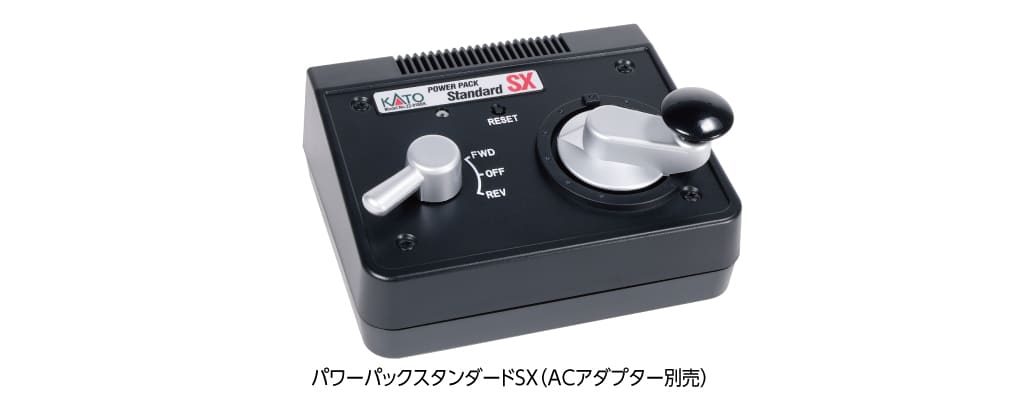
In Japan the controller is called a "power pack" (パワーパック) or "power unit" (パワーユニット). It steps household 100 V AC down to DC for the trains and varies the voltage 18. People usually use a controller from the same maker as their track 18. The two makers' entry-level models:
| KATO Power Pack Standard SX | TOMIX TCS Power Unit N-600 | |
|---|---|---|
| Price on the maker's site (incl. tax) | ¥6,600 (AC adapter sold separately) 24 | ¥7,700 25 |
| Output | DC 0 to 16 V, 1.2 A 24 | DC 0 to 12 V, 1 A 25 |
| Changing direction | A direction lever on the unit (FWD / OFF / REV, see the photo below) | A direction switch for forward and reverse 25 |
| Lights when stopped | Lights can stay on when stopped (depends on the train) 24 | No constant-lighting function 25 |
Constant lighting and interior lights
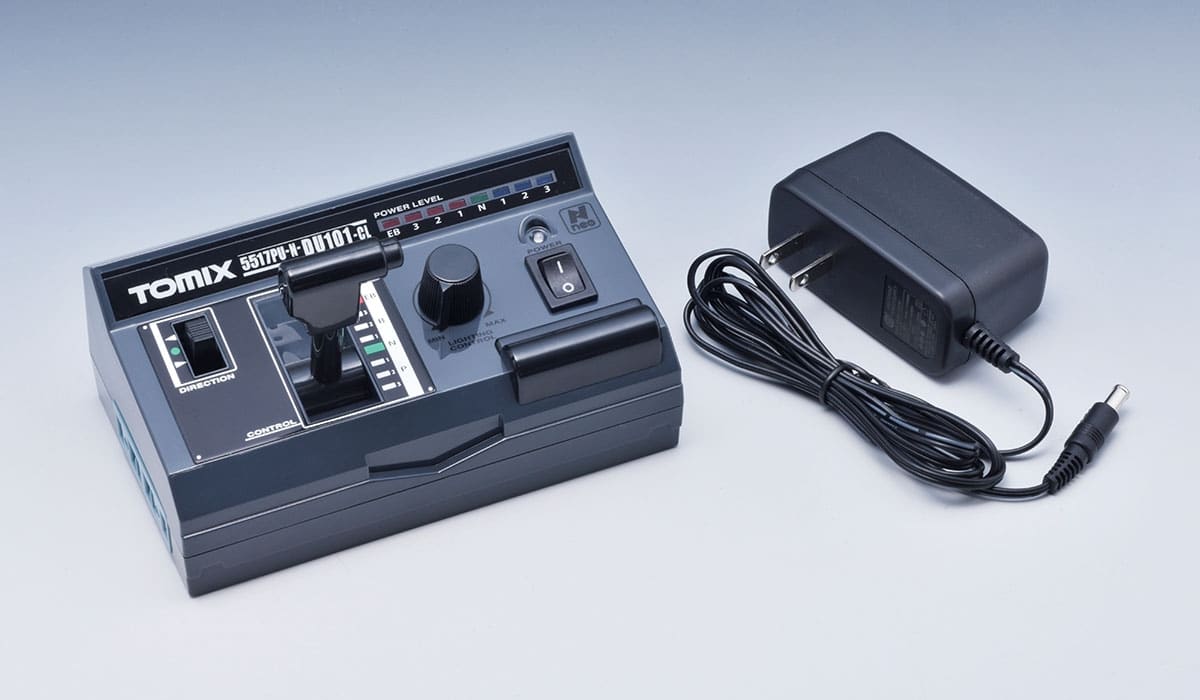
Japanese modellers often talk about "constant lighting" (常点灯): the head lights and the lights inside the cars stay on even when the train is stopped. TOMIX has offered controllers with constant lighting for a long time 23. "CL" at the end of a model name means constant lighting; the TCS Power Unit N-DU101-CL, for example, lists "constant lighting (CL) function" and costs ¥17,380 on TOMIX's site 26.
Interior lights (室内灯) are usually bought separately and fitted into the cars. Many of TOMIX's interior light units support constant lighting, and besides TOMIX's own trains they fit most Greenmax and Micro Ace cars 23.
DCC in Japan: available, but not mainstream
DCC has spread mainly in Europe and America; in Japan it is still being introduced and promoted 18. Before the NMRA set a common standard, each maker's digital system was incompatible with the others, and KATO had its own "KATO Digital" 21.
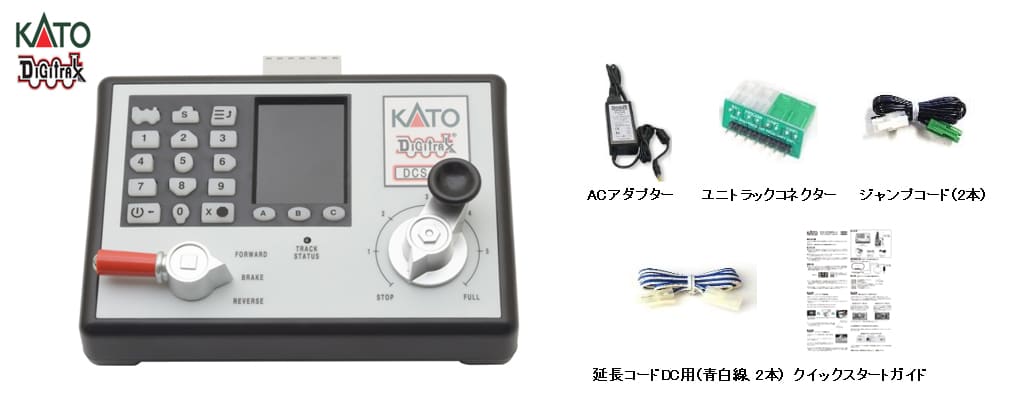
Today KATO sells DCC equipment in partnership with Digitrax of the US. Its early entry-level controller was the D101 22, and its current D103 DCC Basic Set costs ¥44,880 on KATO's site 27. Many KATO trains are "DCC friendly", meaning a decoder can be dropped in easily 22. The D103 has a "Jump Port" that lets you plug in an analog controller you already own and use it as the throttle for a second train 2227.
TOMIX's powered cars do not support DCC 23. TOMIX went a different way: TNOS, launched in 2017, is an automatic multi-train system that runs several trains at once with block signalling like the real thing, without modifying the trains 2328. The basic set runs two trains automatically at the same time and costs ¥50,600 on TOMIX's site 28.
We found no reliable figures or explanation for why DCC is less common in Japan. Two things we noticed: TOMIX, one of Japan's two main track systems, doesn't support DCC in its trains 23, and an entry-level analog controller costs six to seven thousand yen while a DCC basic set costs over forty thousand 242527.
How a beginner should choose: two steps
Step 1: AC or DC
- If you like German trains and want to lay any track shape without wiring headaches, choose Märklin three-rail AC 12.
- If you want two rails that look more like the real thing, or want trains from outside Germany and a wider choice of brands, choose two-rail DC 2.
- Keep in mind that Märklin's own Trix brand makes the same models as Märklin, for DC 9. Liking Märklin's models doesn't force you into AC.
- For Japanese trains there is nothing to choose: they are all two-rail DC 1819.
Step 2: analog or digital
- On a tight budget, running one train: analog.
- Several trains at once, or sound: digital. On the AC side that mostly means Märklin's own system (mfx/MM, which also handles DCC) 7; on the DC side it means DCC 4.
(These "how to choose" steps are the editor's suggestions, not rules from any standard.)
Telling AC and DC versions apart on second-hand sites
Many makers sell the same model in both an AC and a DC version. In second-hand listings they look almost identical, which makes it easy to buy the wrong one. Check these three things.
1. Look for a slider underneath
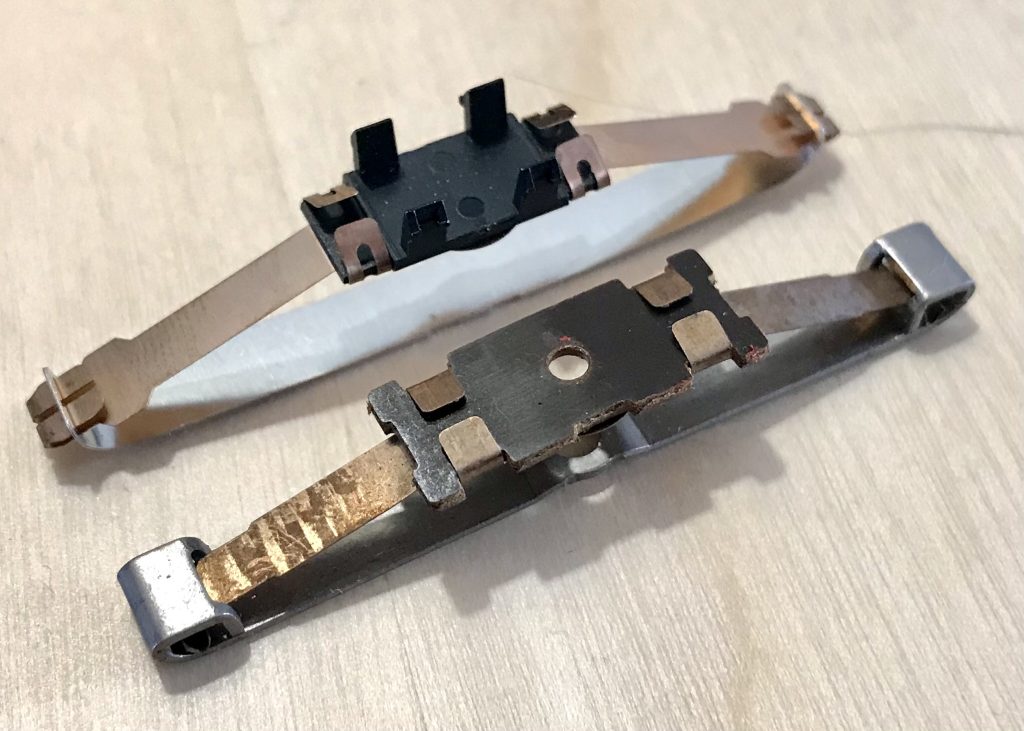
The quickest check is to turn the model over. An AC locomotive has a long slider in the middle of its underside, which picks up power from the centre contacts 2. A DC locomotive has none and picks up power through its wheels. If the seller hasn't photographed the underside, ask for a picture.
2. Read the product name and the box
Proper shops and the brands themselves state the system in the name:
- "AC", "Wechselstrom" (alternating current) or "3-Leiter" (three-conductor) means an AC version. In one Swiss shop's list of Roco AC locomotives, every name ends in "AC" 12, and Fleischmann 391973 is listed as "AC-SOUND" and "3-Leiter Wechselstrom" 15.
- "DC", "Gleichstrom" (direct current) or "2-Leiter" (two-conductor) means a DC version. Roco 7510109, for example, is listed as "H0 DC Sound" 13.
3. Learn the article number patterns (by brand)
| Brand | Pattern | Example |
|---|---|---|
| Märklin / Trix | HO models under the Märklin name are AC; the DC version of the same model comes out under the Trix name 19 | If it says Trix, it is DC |
| Roco (7-digit numbers, from 2023) | The third digit marks the version: 750xxxx = analog DC, 751xxxx = digital DC, 752xxxx = digital AC 1117 | DB 144 029-6: 7500078 (analog DC) / 7510078 (digital DC) / 7520078 (digital AC) 11 |
| Roco (older 5-digit numbers) | A forum post says 62xxx and 63xxx are DC and 68xxx and 69xxx are AC 16, but the pattern varied over the years (not fully verified) | Go by the product description |
| Fleischmann | Mainly two-rail DC, but some locomotives also came in Märklin-compatible three-rail versions 10; AC versions in one second-hand shop's list include numbers like 1145 and 1327 and also 4103 14, so the number alone won't tell you | Check the description and the underside |
Since 2019, Fleischmann's HO range has been sold under the Roco name, and the Fleischmann name is kept only for N scale 10. For newer Fleischmann designs, look for the HO version under Roco.
Common pitfalls
- Putting a Märklin model on another maker's two-rail track causes a short circuit, because the wheels are not insulated 1. The other way round, a DC locomotive won't run on Märklin track 2.
- Thinking that "digital" lets AC trains run on DC track. It doesn't; the electrical layout of the track and wheels is unchanged (see above).
- Buying second-hand from a photo of the side only. AC and DC versions look the same, so always check for a slider underneath and for AC or DC in the product name 21213.
- Assuming a Märklin model means AC. Trix is Märklin's DC brand, and its models largely overlap with Märklin's 9.
- Applying Roco's new number pattern to old numbers. The 750/751/752 rule only covers the 7-digit numbers used since 2023 1117; the older 5-digit numbers don't follow one pattern 16.
- Laying a reversing loop on two-rail DC without the extra circuit, which causes a short circuit. Loops need special handling 2; Märklin three-rail track doesn't have this problem 2.
Related terms
Sources
The numbers match the [n] markers in the text. Sources 1 to 17 were accessed on 2026-10-05, sources 18 to 28 on 2026-10-07.
- Wikipedia, Märklin
- German Wikipedia, Modelleisenbahngleissysteme der Spur H0 (H0 track systems)
- German Wikipedia, Modelleisenbahnsteuerung (model railway control)
- Wikipedia, Digital Command Control
- NMRA, DCC Working Group
- Wikipedia, Märklin Digital
- Märklin product page, Central Station 60215
- Märklin product page, "Regional Express" Digital Starter Set 29479
- German Wikipedia, Trix
- Wikipedia, Fleischmann (model railroads)
- modellbahninfo.org, Baureihe 144 / E 44 / DR 244: Roco 7500078 / 7500124 / 7500079 (5 February 2025)
- amiba-shop.ch, Roco H0 AC locomotives category page
- Modellbahn-Kramm, Roco 7510109 product page
- gebrauchtemodellbahnen.ch, second-hand Fleischmann H0 AC locomotives
- Härtle, Fleischmann 391973 product page
- Stummis Modellbahnforum, Nummernschema von Roco H0 (post by Dirk Ackermann, 11 December 2009; forum source, for reference only)
- Mostviertler Modellbahnhof, ROCO Frühjahrsneuheiten 2023
- Wikipedia (Japanese), Nゲージ (N gauge)
- Wikipedia (Japanese), 16番ゲージ (16-ban gauge)
- Wikipedia (Japanese), HOゲージ (HO gauge)
- Wikipedia (Japanese), デジタルコマンドコントロール (Digital Command Control)
- Wikipedia (Japanese), 関水金属 (Sekisui Kinzoku / KATO)
- Wikipedia (Japanese), TOMIX
- KATO, Power Pack Standard SX (22-018BK)
- TOMIX, TCS Power Unit N-600 (5507)
- TOMIX, TCS Power Unit N-DU101-CL (5517)
- KATO, D103 DCC Basic Set (29-125)
- TOMIX, TNOS control system basic set (5701)
Updated 2026-10-07