

Scales and gauges: choosing between Z, N, TT, HO, O and G
Model trains come in several sizes. The common ones are Z, N, TT, HO, O and G. This article covers the scale and track gauge of each, how big the models actually are, how much room they need, who each size suits, and where most beginners start.
Two words to keep apart: scale and gauge
Scale (German: Maßstab) is how much the model is shrunk compared with the real train. 1:87 means 1 mm on the model stands for 87 mm on the real thing.
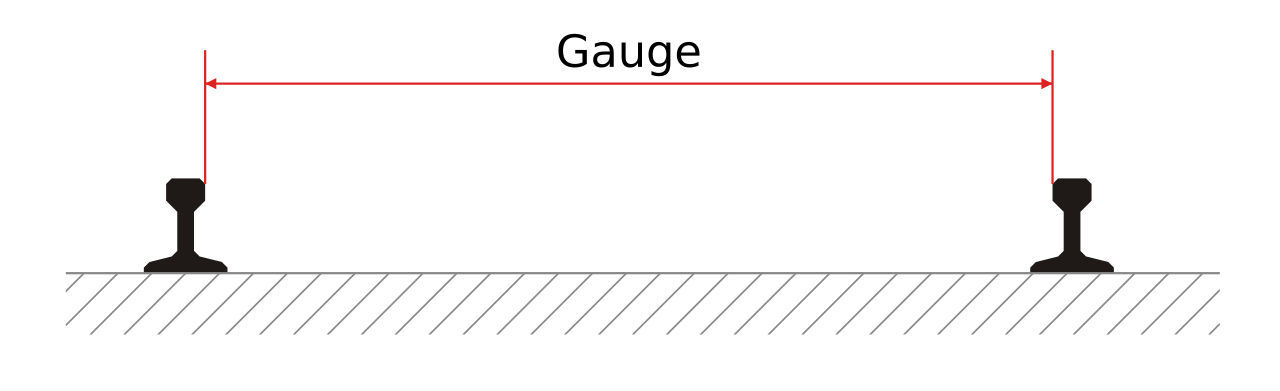
Gauge (German: Spurweite) is the distance between the inner edges of the two rails, in millimetres. Whether a model can run on a given track depends on the gauge.
The two go together. Real standard-gauge track is 1435 mm wide; shrink that by 87 and you get about 16.5 mm, which is why HO track is 16.5 mm 15.
European standards bundle both into a single label called the nominal size (German: Nenngröße). Saying "H0" means 1:87 scale and 16.5 mm gauge at the same time 1.
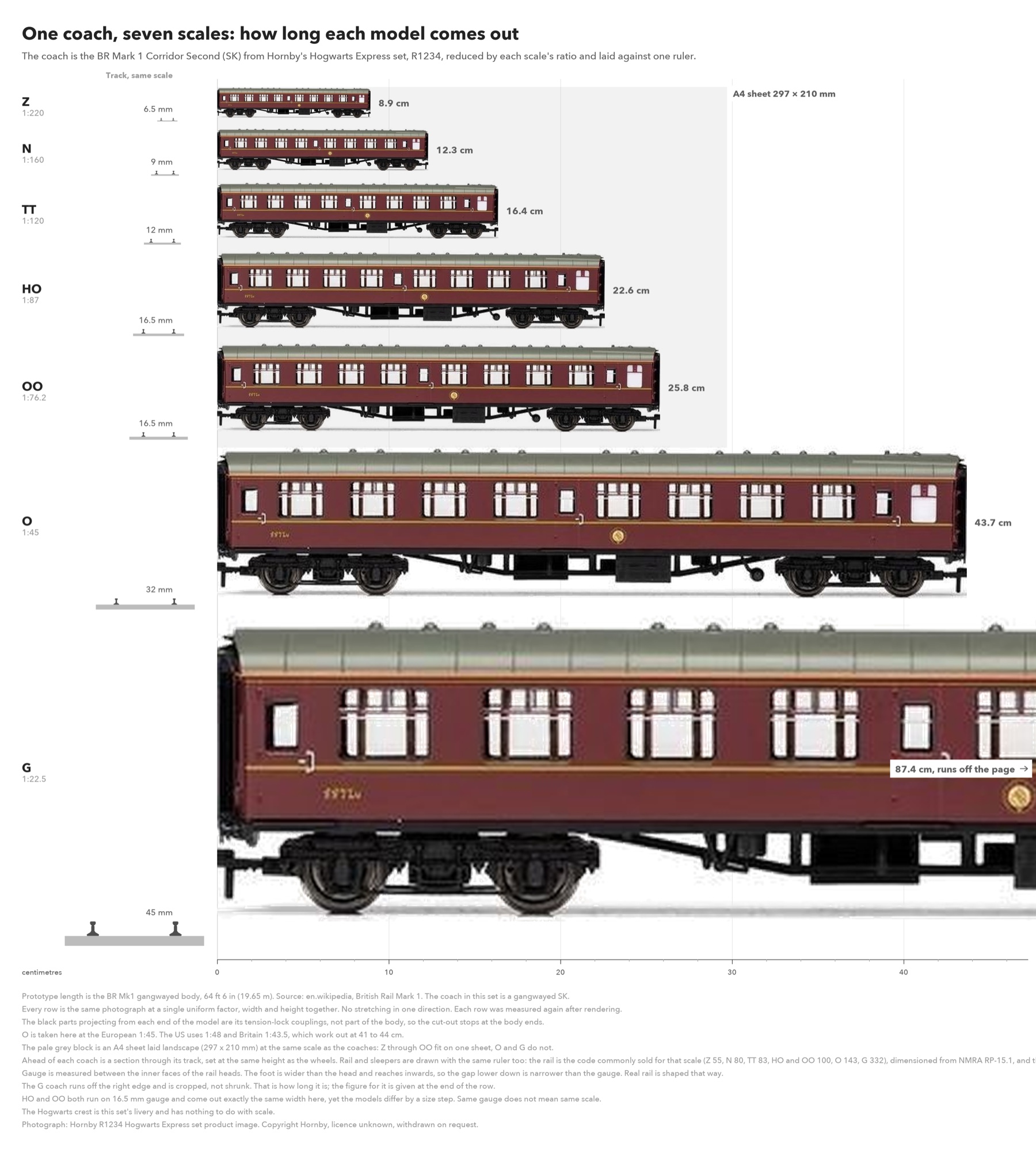
The six common sizes compared
The figures below follow the European NEM 010 standard and the American NMRA standards. Where the two differ, the table says so 12.
| Size | Scale | Gauge | A 20 m coach as a model* | A 1.75 m person as a figure* | Typical tightest curve radius (example) |
|---|---|---|---|---|---|
| Z | 1:220 127 | 6.5 mm 127 | 9 cm | 8 mm | 145 mm (Märklin) 1819 |
| N | 1:160 (most Japanese models 1:150) 12614 | 9 mm 126 | 12.5 cm (13.3 cm at 1:150) | 11 mm | 249 mm (Kato) 2021 |
| TT | 1:120 128 | 12 mm 128 | 16.7 cm | 15 mm | not verified |
| HO / H0 | 1:87 (NMRA: 1:87.1) 125 | 16.5 mm 125 | 23 cm | 2 cm | 360 mm (Märklin C Track R1) 17 |
| O | 1:45 or 1:43.5 (Europe) / 1:48 (US) 129 | 32 mm 129 | 42 to 46 cm | about 4 cm | not verified |
| G | several; LGB uses 1:22.5 101112 | 45 mm 1210 | 89 cm (at 1:22.5) | about 8 cm | 600 mm (LGB R1) 2223 |
\* These two columns are rough conversions (real size divided by the scale), not official figures. They are only there to give you a feel for the size.
The tightest curve radius decides how much floor a simple loop of track needs: the circle is about twice the radius across. From the table, a circle is roughly 30 cm wide in Z, 50 cm in N, 72 cm in HO and 1.2 m in G (an LGB R1 circle is 1200 mm across 22). In practice you also need room for the width of the track and the overhang of the cars, plus some margin.
Who each size suits
The "who it suits" notes below are the editor's summary based on the sizes above and how popular each scale is. They are suggestions, not rules from any standard.
Z (1:220): the smallest, for very tight spaces and miniature scenes
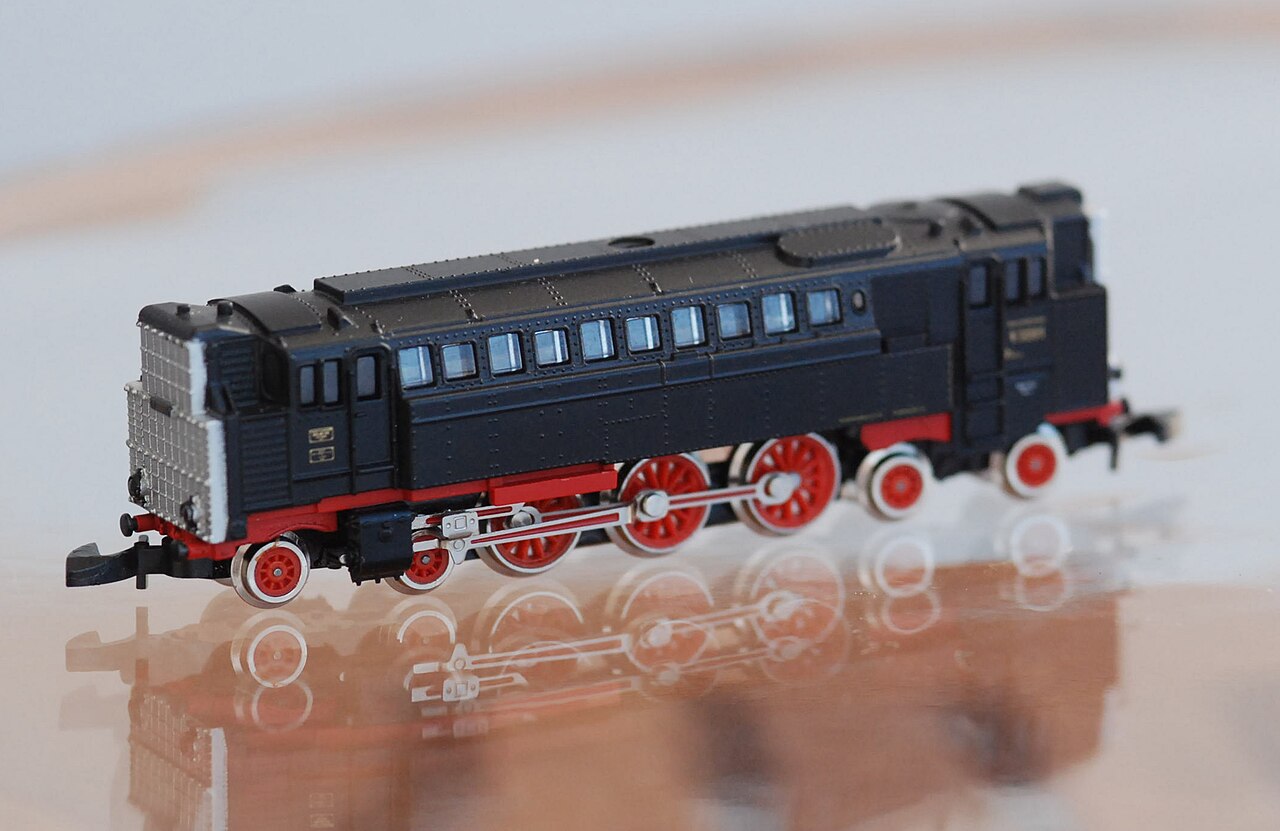
Märklin launched Z in 1972 under the name mini-club. It is one of the smallest commercial scales on the market 713. You can fit more track into the same area 7, but the market is small and the range of products is limited 7. The models are tiny, so putting them on the track, cleaning them and fixing them takes steady hands and good eyes.
N (1:160 / Japan 1:150): the first choice when space is short
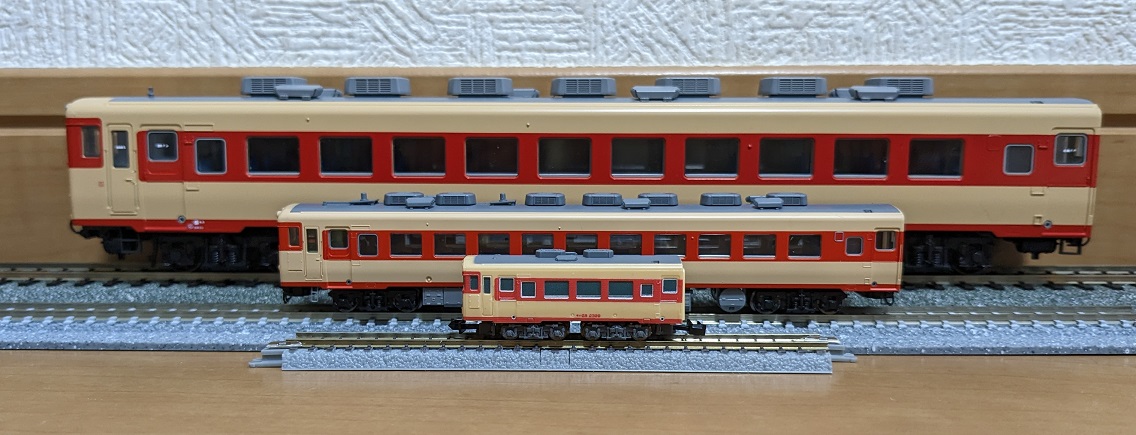
N is second only to HO in popularity and is the most popular scale in Japan 6. Märklin also calls N the second-largest segment of the model railway market 12. N models are roughly half the size of HO, so the same area holds a much longer run of track 6.
Japanese-outline N models are made to 1:150, except Shinkansen bullet trains, which use 1:160 14. Most Japanese railways run on narrow 1067 mm gauge, and 1:150 keeps Japanese models from looking much smaller than European and American ones; that was the reason for choosing it 14. Both scales use 9 mm track, so they run on the same rails, but side by side the car bodies differ in size.
N couplers were historically standardised on Arnold's Rapido design. Arnold let other manufacturers use it, so cars from different brands can usually be coupled together 6.
TT (1:120): between N and HO, more common in Central Europe
The name TT comes from "table top" 8. It started in the US but became popular mainly in Central Europe, especially the former East Germany 8. Tillig is currently the largest TT maker, and most TT track on sale is made by Tillig 8. TT has picked up again in recent years: Piko and Roco make TT models, and Hornby in the UK launched its TT:120 range in October 2023 8. If you mainly want German, Czech, Polish or other Central and Eastern European trains, TT is worth a look. For Japanese or American trains the choice is much smaller.
HO / H0 (1:87): where most beginners start
HO is the most popular model railway scale in the world 5 and the main scale in both continental Europe and North America 5. Most of Märklin's products are HO too 12. Because so many people model in HO, there is a huge range of models, kits and supplies 5, and the second-hand market is the largest as well (the editor's inference; no figures found). English Wikipedia describes HO as a balance between detail and space 5: the models are big enough to handle easily and show their detail, and the smallest loop takes about 72 cm by 72 cm.
O (1:43.5 / 1:45 / 1:48): large models that need a room of their own
O is one of the oldest scales; Märklin introduced it around 1900 9. From the 1930s to the early 1960s, three-rail AC O gauge toy trains such as Lionel were the most common kind in the US 9. The scale depends on the region: 1:43.5 in Britain, 1:43.5 or 1:45 in continental Europe, and 1:48 in the US, but the gauge is about 32 mm in all of them 129. The models are big and have real weight in the hand. O suits people with a dedicated room who like large, detailed models.
G (45 mm gauge, several scales): garden railways
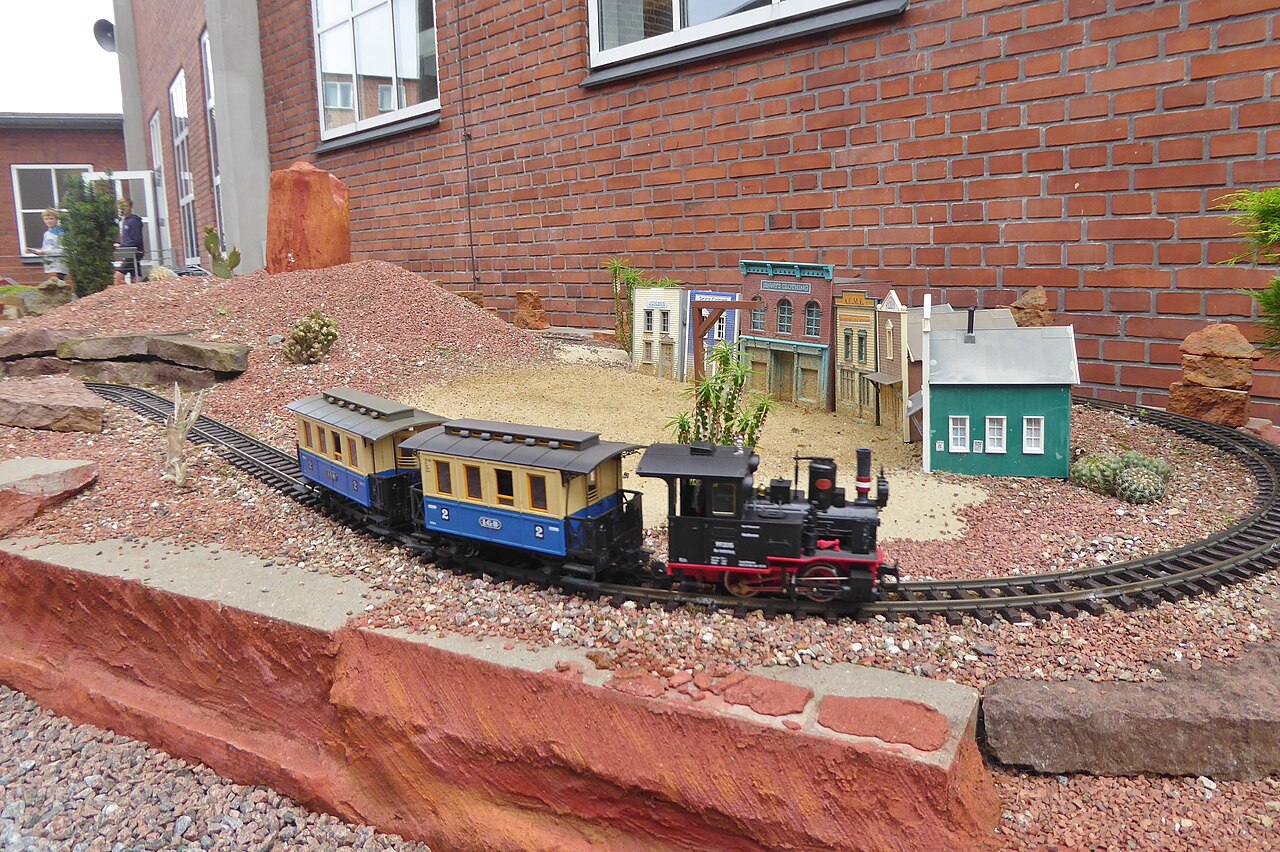
G is not one fixed scale. It covers large models that run on 45 mm track, at scales including 1:22.5, 1:20.3, 1:29 and 1:32 210. The "G" comes from the German word groß, meaning big 10. The best-known G brand is LGB (Lehmann Groß Bahn), launched in 1968 1011 and owned by Märklin since 2007 1112. LGB builds European metre-gauge (1000 mm) trains at 1:22.5 11; under the European standard that combination is called IIm rather than a size of its own 1.
G is often used for outdoor garden railways because the models are large and tough, and brass track stands up to sun and rain 1012. Even the tightest LGB curve has a 600 mm radius 2223, so G generally does not fit on a desk indoors.
Which size should a beginner pick?
The editor's suggestions:
- If you have room for a board or table of about 1 m × 2 m, choose HO. It has the most modellers and the most products 5, which makes help easy to find and second-hand models easy to buy.
- If you live in a flat and only have a desk or a shelf, choose N. The same space holds far more track than HO 6, and N is the second most popular scale 612. If you want Japanese trains, N is the obvious choice, since it is the most popular scale in Japan 6.
- Leave Z, TT, O and G until you know what you want (extreme miniaturisation, Eastern European trains, big models, or a garden line).
The "1 m × 2 m" figure is the editor's estimate: an HO loop about 72 cm wide plus some room for sidings and margin. It is not a standard figure.
HO and H0: two spellings
HO and H0 are the same size. The name means "half O", because 1:87 is roughly half of O 5. The European NEM standards write H0 with a zero, read "H-zero" (in German, "ha-null") 145; the American NMRA and the English-speaking world write HO with the letter O 4. When you search German or Japanese second-hand sites, try both spellings.
European NEM and American NMRA: the short version
- NEM (Normen Europäischer Modellbahnen, the European model railway standards) are maintained by MOROP, the European federation of model railway associations. The NMRA is the National Model Railroad Association of the United States 13.
- For the main scales and gauges the two agree: Z, N, TT and HO use the same figures 12.
- O scale differs: NEM uses 1:45 (1:43.5 in some countries), the NMRA uses 1:48 12.
- HO is written with different precision: NEM says 1:87, the NMRA says 1:87.1 (3.5 mm to the foot) 125.
- Narrow gauge is named differently. NEM adds a letter to the nominal size: m for prototype gauges from 850 mm up to 1250 mm (typically 1000 mm metre gauge) and e for 650 to 850 mm (for example 750 or 760 mm) 1. The NMRA adds "n" plus the prototype gauge in feet, so HOn3 means a 3 ft prototype gauge, modelled on 10.5 mm track 2. Both model narrow gauge of around 3 ft, but European H0m uses 12 mm track and American HOn3 uses 10.5 mm, so they don't mix 12.
- The NMRA itself notes that sizes such as II are maintained by MOROP in the NEM standards 3, and NEM points to the NMRA standards for gauges and sizes that are uncommon in Europe 1.
Same scale, different gauge: HOm and HOe
Many real railways are narrower than standard gauge (1435 mm). Models show this with a suffix after the size: H0m is a 1:87 metre-gauge train on 12 mm track, and H0e is a 1:87 train of the 650 to 850 mm class (for example 760 mm) on 9 mm track 145. So an H0e train runs on the same 9 mm track as N, but its body is HO-sized.
Common pitfalls
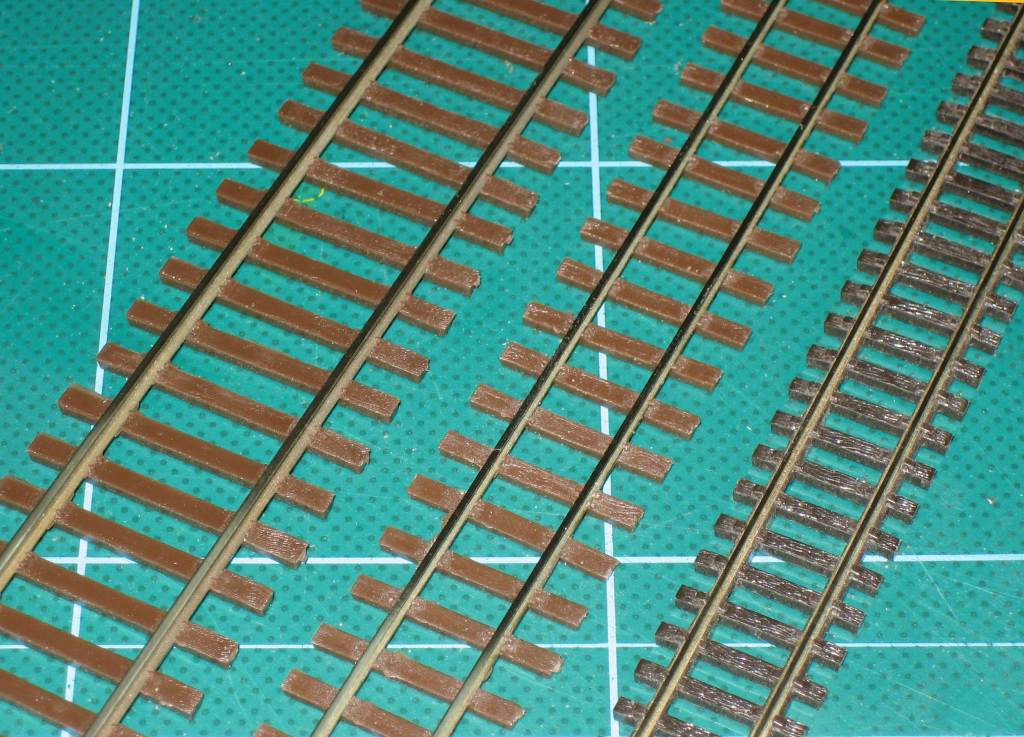
- Same gauge does not mean same scale. British OO is 1:76.2 and also runs on 16.5 mm track 45; Japanese "16-ban" models are 1:80, again on 16.5 mm track 155. They run on HO track, but they are noticeably larger than 1:87 HO and look odd next to it. Some Japanese shops and modellers call 1:80 "HO" too, which is not correct by the standards 15.
- N has two scales. Japanese models are 1:150, European and American ones 1:160. The track is the same; the body sizes are not 144.
- Märklin HO is three-rail AC and doesn't work with most two-rail DC HO. Märklin wheels are not insulated, so they short-circuit on other makers' two-rail track 13. Before you buy HO, check whether it is for the Märklin system or for two-rail DC (the article on AC and DC covers this in detail).
- "G" is not one scale. On the same 45 mm track, 1:22.5, 1:29 and 1:32 models differ a lot in size 210, so check the scale before mixing them.
- Don't judge narrow gauge by the track alone. 9 mm track might carry N trains or H0e trains 15; 12 mm track might be TT or H0m 1. Check the suffix on the size when you buy.
- Watch the spelling when you search second-hand listings. Search for both HO and H0 14. German listings often use "Spur" to mean gauge or size, as in Spur N or Spur Z (the glossary will cover it).
Related terms
Sources
All accessed 2026-10-05. The numbers match the [n] markers in the text.
- MOROP, NEM 010 *Scales, Nominal Sizes, Gauges* (2011 English edition, binding standard)
- NMRA Standard S-3.2 *Track, Standard Scale* (28 June 2026)
- NMRA Standard S-1.2 *List of Standard Scales* (19 May 2026)
- Wikipedia, *Rail transport modelling scales*
- Wikipedia, *HO scale*
- Wikipedia, *N scale*
- Wikipedia, *Z scale*
- Wikipedia, *TT scale*
- Wikipedia, *O scale*
- Wikipedia, *G scale*
- Wikipedia, *LGB (trains)*)
- Märklin, *Our brands*
- Wikipedia, *Märklin*
- Japanese Wikipedia, *Nゲージ* (N gauge)
- Japanese Wikipedia, *16番ゲージ* (16-ban gauge)
- KATO UNITRACK official site
- Märklin product page, item 24130 (C Track curve R1)
- Märklin product page, item 8510 (Z curved track)
- Märklin, Z scale track catalogue
- Midwest Model Railroad, Kato 20-100 product page
- Lombard Hobby, Kato 20-100 product page
- Large Scale Insider, *G Scale Track Geometry Series 1: LGB* (15 April 2025)
- Upland Trains, LGB 11000 product page
Updated 2026-10-06